NexGen 7T Hardware Engineering
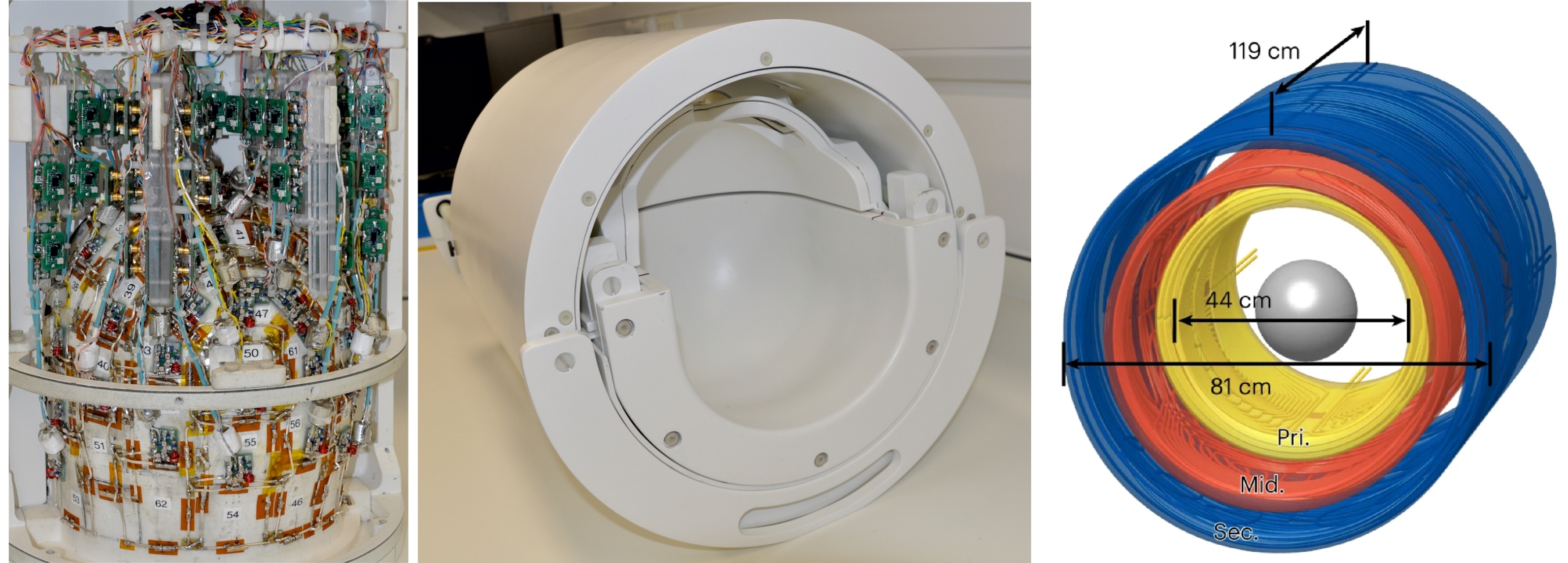
The core of our lab focuses on the physical limits of MRI. By developing asymmetric gradient coils that reach 200 mT/m, we have moved beyond the capabilities of standard commercial systems. This hardware allows us to encode spatial information at a grain size previously impossible in humans, overcoming traditional constraints of Signal-to-Noise Ratio (SNR).
To reach ultra-high resolution the scanner required making several advances in hardware. To improve spatial encoding and increase the image SNR, we developed with Siemens a head-only asymmetric gradient coil, Impulse gradient (200 mT/m, 900 T/m/s) with an innovative third layer of windings which gives an additional degree of freedom to minimize vibrations, acoustic noise and peripheral nerve stimulation (PNS).
Laminar & Columnar Functional Imaging
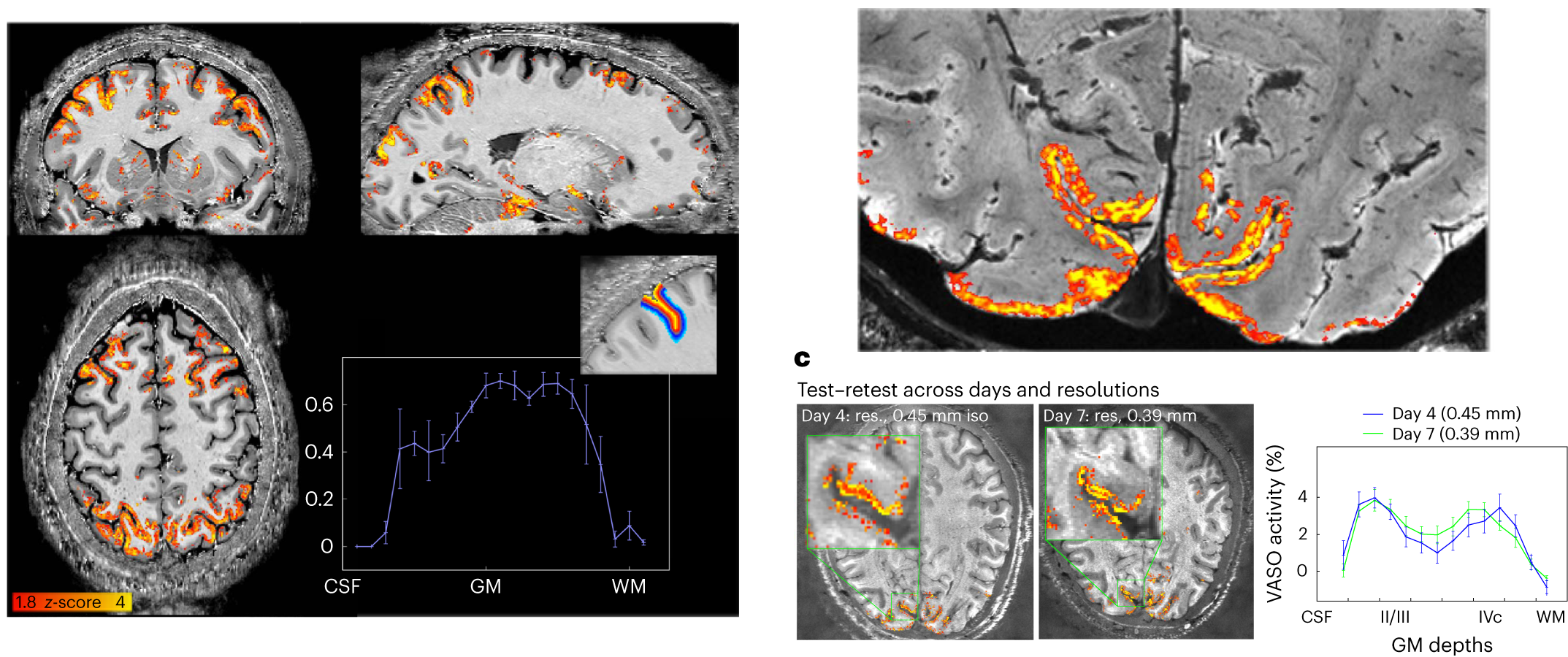
We are pioneering techniques to resolve activity within the 2-3mm thickness of the human cerebral cortex. By distinguishing between the superficial, middle, and deep layers of the gray matter, we can differentiate between "bottom-up" sensory inputs and "top-down" cognitive feedback.
The NexGen 7T system currently has the highest-performance head gradients in a human 7T MRI scanner, creating a new operating regime for functional MRI and diffusion MRI. The scanner routinely performs functional imaging studies at 0.35–0.85 mm isotropic spatial resolution to reveal cortical layer functional activity, and achieves unprecedented high resolution in human brain functional imaging at 7T.
Diffusion Imaging
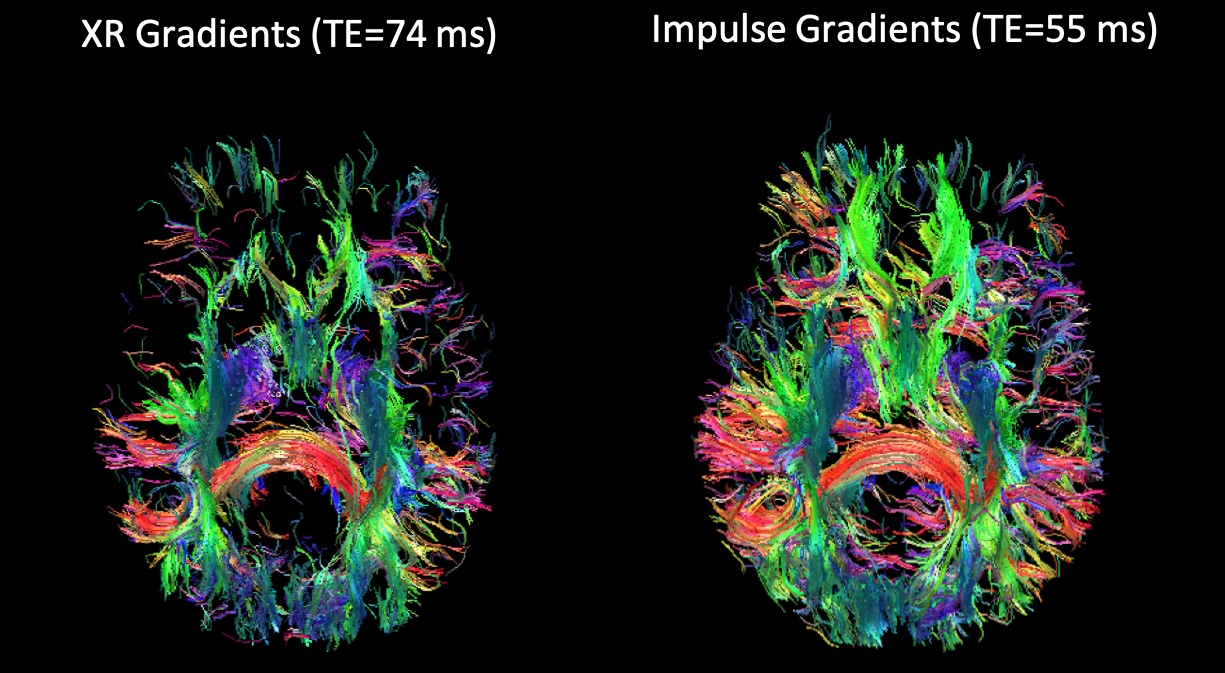
The NexGen 7T system currently has the highest-performance head gradients in a human 7T MRI scanner, creating a new operating regime for diffusion MRI. This regime supports ultra-high b-values while preserving SNR and spatial resolution.
Emerging results on the NexGen 7T show that combining ultra-high field strength with high-performance gradients improves SNR efficiency and enables simultaneous gains in both spatial and angular resolution of diffusion imaging beyond current state-of-the-art 3T diffusion scanners and 7T scanners. By optimizing the hardware of the NexGen 7T scanner with high-performance gradients and larger receiver arrays, the new diffusion encoding regimes yield substantial gains in tractography fidelity and microstructural specificity beyond what is achievable on current state-of-the-art 3T and 7T scanners. The NexGen 7T scanner achieves robust mapping of human brain connectivity and microstructure at spatial and biophysical scales critical to the study of neural circuitry and disease.
SMS and Multiband Innovation
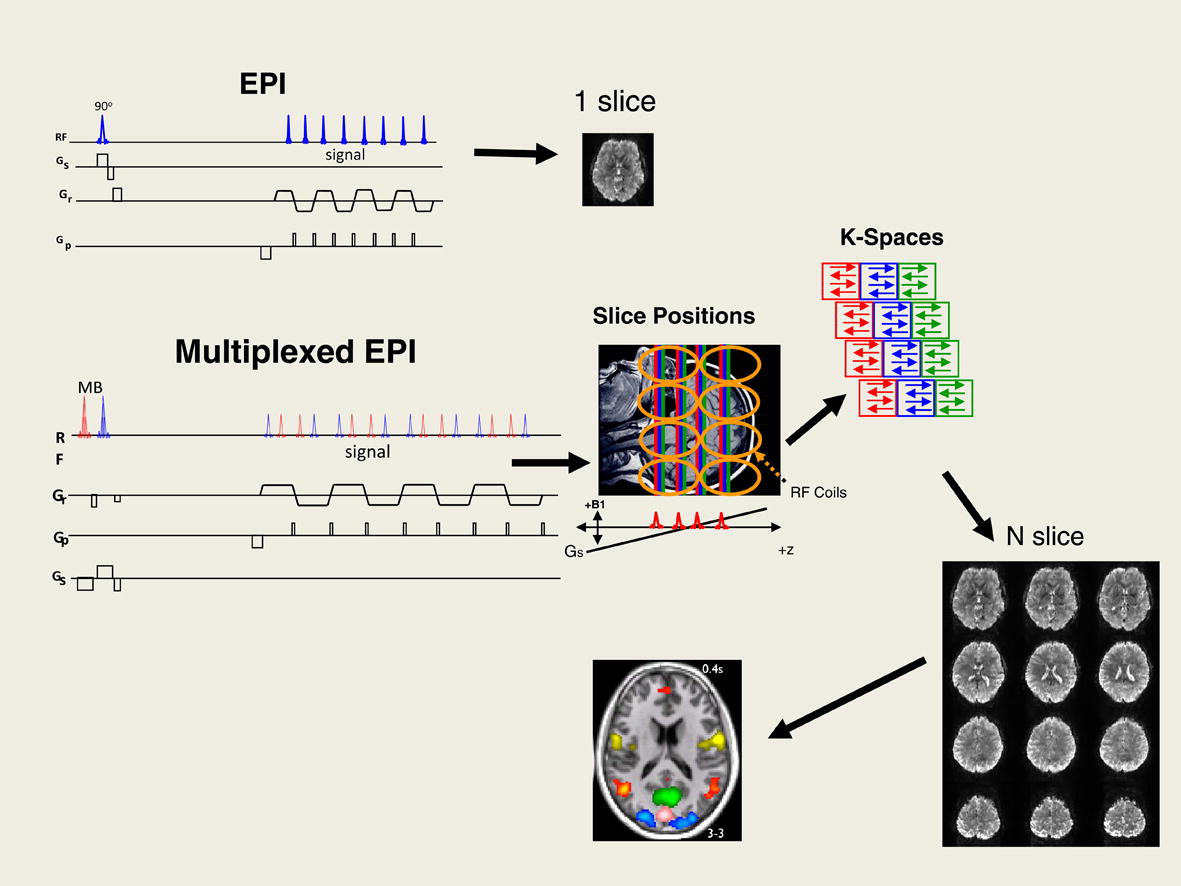
Our lab developed the Simultaneous Multi-Slice (SMS) and Multiband techniques that have become the global standard for the Human Connectome Project. We continue to innovate in "multiplexed" imaging, allowing for sub-second whole-brain acquisitions.
The scanner has integrated a 128-channel receiver system with 64- and 96-channel receiver coil arrays to boost signal in the brain cortex close to the coil array while reducing g-factor noise to enable higher accelerations for faster imaging. A 16-channel transmit system reduced power deposition and improved image uniformity.