NexGen 7T Scanner
The NexGen 7 Tesla scanner has been developed at Berkeley in collaboration with Siemens and MR CoilTech LTD to improve the spatial resolution of MRI. The scanner was designed for ultra-high resolution (mesoscale) human brain research at up to 10 times more detail than current 7T scanners and over 50 times more detail than current 3T scanners. The scanner is described in a paper published in Nature Methods, December 2023, showing technical details and examples of the scanner dramatically improving resolution in functional MRI (fMRI) by achieving 0.4 millimeter resolution compared to the 2 - 3 millimeters typical of today's standard 3T scanners.
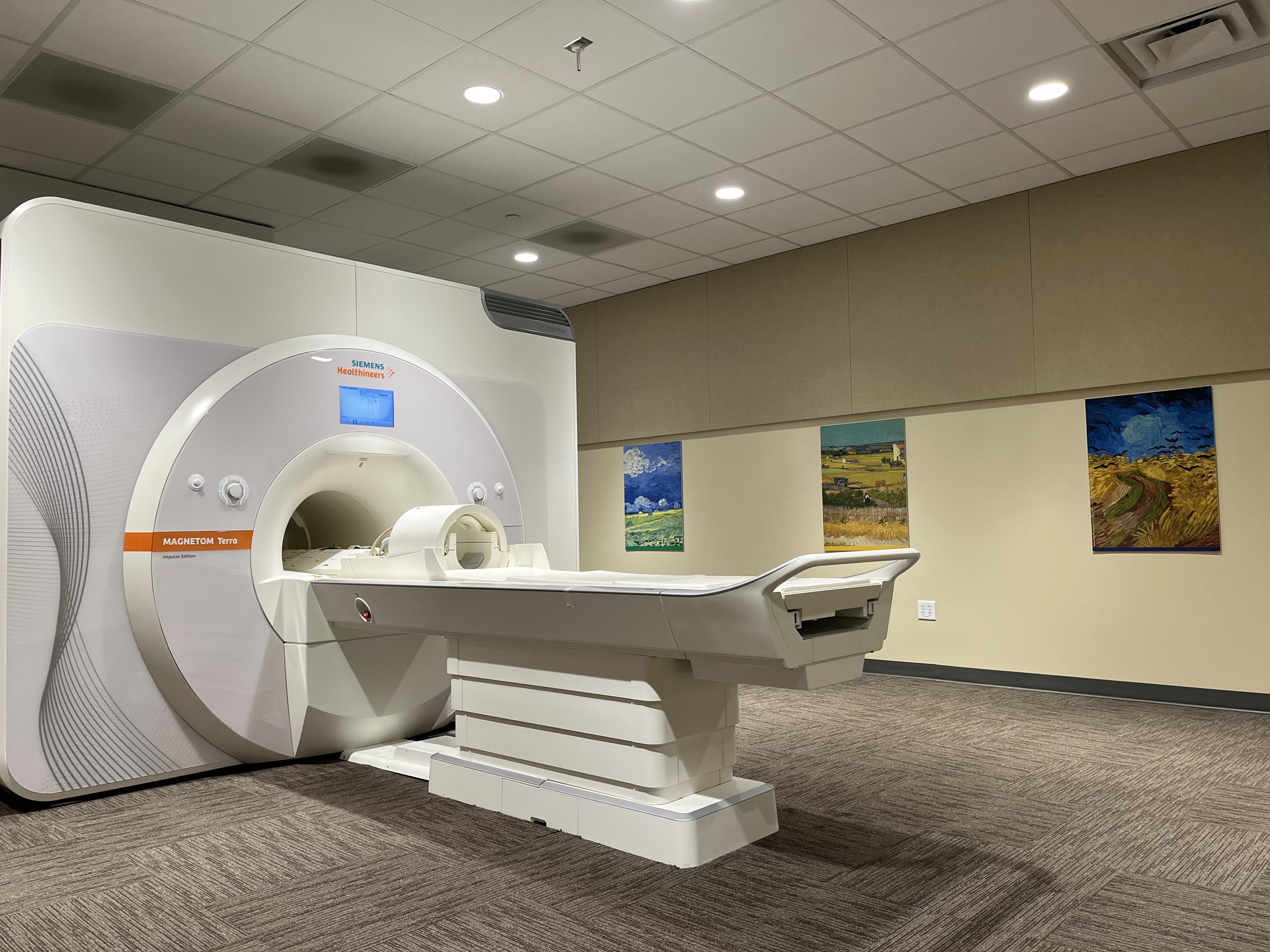
To reach ultra-high resolution the scanner required making several advances in hardware. To improve spatial encoding and increase the image SNR, we developed with Siemens a head-only asymmetric gradient coil, Impulse gradient (200 mT/m, 900 T/m/s) with an innovative third layer of windings which gives an additional degree of freedom to minimize vibrations, acoustic noise and peripheral nerve stimulation (PNS). The scanner has integrated a 128-channel receiver system with 64- and 96-channel receiver coil arrays to boost signal in the brain cortex close to the coil array while reducing g-factor noise to enable higher accelerations for faster imaging. A 16-channel transmit system reduced power deposition and improved image uniformity.